AI coding tools tripled output on GitHub. Releases rose 30%. A Wharton study says reviews are the bottleneck.
Wharton and MIT researchers tracked 100,000 GitHub developers from 2022 to 2026 and found each generation of AI coding tools boosted coding activity sharply — while the gains in finished, released software lagged far behind.
In a working paper published by NBER, Mert Demirer, Leon Musolff, and Liyuan Yang examine AI coding tool adoption by more than 100,000 GitHub developers. They combine public development activity with tool usage data to estimate how autocomplete, local agents, and autonomous agents affect work at different stages of software production.
More code, fewer releases
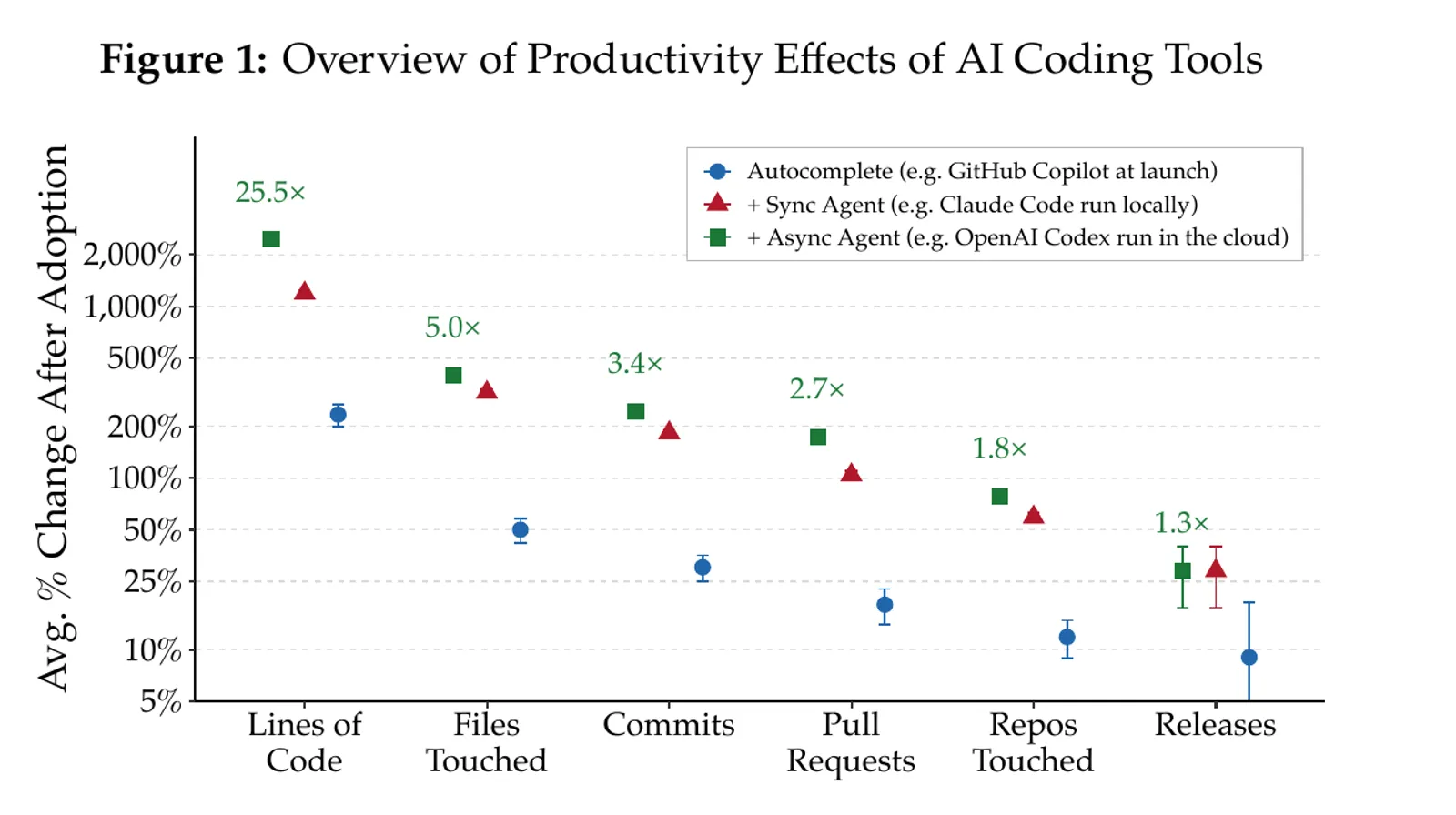
The authors estimate that autocomplete increased commit activity by about 40%. The cumulative effect rose to about 140% with synchronous agents and 180% when asynchronous agents were included. Those are estimates for coding activity, measured through commits, rather than for finished software. The gains shrink at later stages. The paper reports roughly 50% more projects and 30% more releases for the full combination of tools. Figure 1 of the paper shows the drop across commits, pull requests, projects, and releases. The researchers also examine the Apple App Store, Google Play, Chrome Web Store, and SourceForge. They report an increase in new applications without a corresponding rise in aggregate usage. Their data do not establish whether review capacity, discovery, demand, or some combination explains that gap.
What the result means
The authors’ discussion points to review, integration, and distribution as likely constraints on how much code becomes useful software. A team measuring AI coding tools should therefore track shipped releases and use, alongside commits and lines of code. The paper is a working paper, and its observational design has limits. The authors use matching and event studies to estimate effects, but the results should not be read as a randomized test of every coding tool or team.